Educational Aesthetics and 'Huggy' subjects

Posted by csdferwEHRTJR Kamis, 10 Februari 2011 0 komentar
The softest aspects of education are hardest to understand, whilst also being the most important. In so many educational situations - particularly those dealing with 'widening participation' students who have had a rough time both in school, and often in home, the natural instinct of compassionate teachers is to give them a hug, if not literally (which perhaps we ought to do more of!), then metaphorically. The experience can be transformative - a 'back to basics' moment which puts everything into perspective.

Unfortunately, our instinct is not to trust our instincts. Often with good reason - physical contact between teachers and learners is like walking a tightrope: clearly dangerous but potentially remarkable. It's easy to break the trust that is necessary (and it only takes one individual to do it), and so it is easier not to trust. But this is a tragedy for education.

Some subjects 'hug' people more than others. I studied music. That hugged and caressed in wonderful ways (and still does). Art, literature, drama, dance all do the same. Engineering doesn't hug so much. But we don't trust the hugging, so we withdraw the funding from those subjects that hug and put it into those that don't. Why? Because we are told those subjects which are 'hard' are useful; huggy ones aren't. But what we mean is that we can rationally justify the 'hard' ones because they are based on reason, and we don't understand hugging.

I think a way of dealing with this is to work towards a deeper rational understanding of huggy subjects, and the efficacy of hugging in general. For most artists, reaching a rational understanding of their art is something they wrestle with as they create. There are good rational places to start. Somehow we have to sort out the relationship between the inner-world of experience and its relationship to the outer world of material and social life. This feels like a 'game'... both Kant and Gadamer thought so... but what's the game? what are the rules? what does the board look like? Harre's Positioning Theory helps me here, as does work on Distributed Cognition.

Maybe with some better models that try to explore the 'game' might we begin to understand what the hugging is all about. Maybe one day we will realise what a terrible mistake we are making in not trusting our instincts!


Baca Selengkapnya ....

Phew!!

Posted by csdferwEHRTJR Rabu, 09 Februari 2011 0 komentar
it's taken me long enough but i think my kitchen is finally okay to show y'all. when we moved in the previous owners had a lot of green accents throughout the house so the kitchen color made sense with their design scheme (real estate listing pic).
when our stuff moved in, the color stuck out a little (and a bomb went off obviously)...
i debated and debated on what direction I wanted to go with the paint colors. i posted lots of pictures.  ultimately, i decided to go w/ my gut, even though it scared me, and go greige on the cabinets and a darker greige on the walls.  here is the picture that inspired my kitchen:
and now, here is my kitchen....and i can officially say i love her!


thanks so much for all of your help- for convincing me to take a leap and not stick w/ white.  i am one happy camper.  next on my list is to find a good, faded oushak rug to plop in front of the sink :)

Baca Selengkapnya ....

Should the UK sell its forests?

Posted by csdferwEHRTJR Selasa, 08 Februari 2011 0 komentar
The UK government is planning to sell off UK forests. It is interesting to see this move as part of a broader trend in servitisation of the economy, for it has resonances with the way we think about education. Basically, the deal is to sell the land to private companies on condition that those companies maintain rights of access, ecology, and leisure facilities. In effect, it will turn those private companies into 'service organisations' who will provide access and ecological services for the benefit of the public. For now, there is no suggestion that those services will not be provided for free. The move has been prompted by criticism of the Forestry commission, which both regulates the care of forests and guards accessibility and sells the wood they contain.

Under the deal, private companies can expect to profit from the sale of wood, whilst potentially exploring ways of profiting from other diversified opportunities which might arise from owning the forest. But what's wrong with this?

I think this is a clear case of where the intrinsic value in a commodity passes to the few. The forestry commission may not terribly effective in managing forests, but it matters that our government owns it. It is an asset whose value lies in what it is, a value which can be passed from one generation to another, which can be maintained and kept by one generation for another. Collective ownership guards against commercial exploitation and slavery in the interests of a few. For it is the principle of good government that "government prevents injustice, other than that which it creates itself." If a government is unjust - or a government agency like the Forestry commission, the people can take it to task in a democracy.

If a company is unjust, it is more difficult for the people - consumers of services - to take it to task. Indeed, it can sometimes appear that the people can only take a service company to task by consuming more services (legal services, for example) which serve to amplify individual complaints to give them greater effect. (to what extent are all legal services 'complaint amplification services'?) Collective ownership on the other hand, means that collective political action (the realisation of the power of organised labour) can effect change without recourse to legal amplification services.

It may be that this is how things have to be. I think however, it is better to know this is how things are becuase only by understanding how things are might an effective way of dealing with the world in this new form be found.


Baca Selengkapnya ....
Posted by csdferwEHRTJR Senin, 07 Februari 2011 0 komentar


i can see the light at the end of the tunnel and it makes me truly happy...
my kitchen is 99% done...i need to clean it up, hang some pictures, and squirt some mrs. meyers and it will be ready to go.  can't thank my dad and hubby enough for doing the backsplash and lighting this weekend!  hope y'all are having a wonderful monday...i can finally say i am :)

Baca Selengkapnya ....

Britten, childhood and home

Posted by csdferwEHRTJR Jumat, 04 Februari 2011 0 komentar
Benjamin Britten's music has always fascinated me. He uses very simple patterns which are almost childlike and naive - it portrays a kind of 'melancholic innocence': a feeling which takes me back to the roots of 'home': security, privacy, intimacy. What is it to be in a place all of your own.

Privacy and intimacy are not features of social technology. Facebook and the like are precisely about popping the bubble of intimacy. What is lost? Britten reminds us. The world of social action and politics take us away from the intimate world. Even the sexual roots of intimacy are to hand (!) online as a public performance. No mystery.

Home may be the root of all mystery. It is where concern and love combine in the chaos of daily life. Where no dogma or ideal can survive the unpredictabilities of individual behaviour. Yet home is where we care and love enough to keep on trying despite the continual (and sometimes joyful) frustration of our expectations. Home doesn't enframe us, we continually make it;

The web is not home. We may use it to explore our ideals and pretend to be the people we would wish to be. But precious few care enough on the web to set us straight by showing us what crooked timbers we really are. And if someone really did care, they wouldn't express that care through the web!

But the transparency of information available through the web can drive concernful homely action. We can pick up signals of those around us which might help us to care for one another better. And in leaving signals for others, we can teach how we feel and what we think in ways that might help us to look after others by bringing the example of our own personal being to-hand. But more importantly, the agency of expressing personal things online is a way of making pointers for ourselves, helping us to chart our own psyche with little pointers for memory of how we were and how we changed. Technology does something to our memory.

But much as all this is good, I am not home online. This is a subtle distinction which I think is very hard to make sometimes. I think I use my being online to explore 'home' within myself: the childlike, naive, secure, private and intimate are always there...

Baca Selengkapnya ....

yea, yea

Posted by csdferwEHRTJR Kamis, 03 Februari 2011 0 komentar
i know, i said i would show y'all this week but it's taking a lot longer then anticipated to get my kitchen back in order.  painting is done and my kitchen is no long bright green, and i think, i kind of like her :)  hope your week is going peachy!

Baca Selengkapnya ....

Home, Technology and Concern

Posted by csdferwEHRTJR Selasa, 01 Februari 2011 0 komentar
What is it to 'be at home'? How does technology affect our 'being at home'? I think I would be at home if I had my family, a piano (important), my books and an internet connection. What is that? How is my experience of home different from previous generations or from other people? What is the relationship between home and geography?

I have been familiar with the patch of ground in Manchester on which I live for over 20 years now. Some of my happiest memories are associated with it. I love the things and places that surround me: gallery, library, church, etc. I also have fond memories of Luton, where I grew up (I am unusual in having fond memories of Luton!). That is a sort of home too, but not one which is actual for me now. It is part of my 'homely' family. Similarly I have fond feelings for London which go deep into childhood: The South Bank, Bloomsbury, Moorgate, Merton Abbey. There is some family resemblance to my home-ness here too.

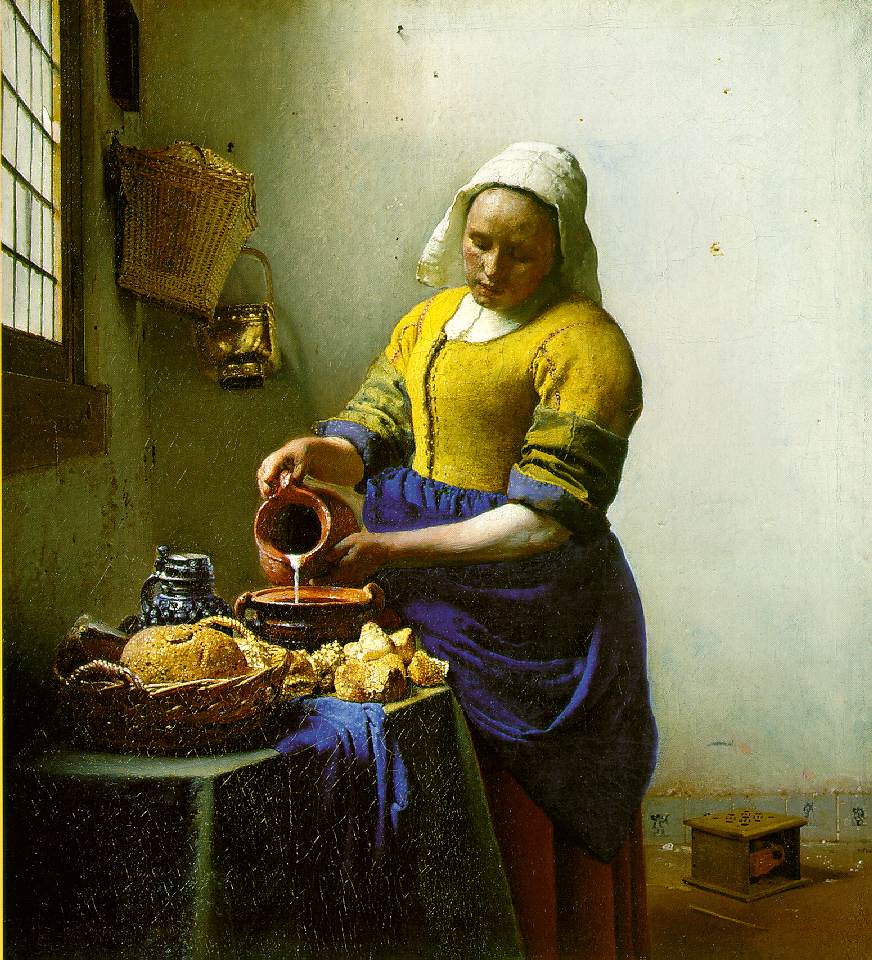
For me, the essence of being at home is being concernfully engaged with the world around me - where I care most deeply about my actions and their consequences on other members of my family. I see this concernfulness reflected in the Vermeer interiors that we saw in the Rijks Museum at the weekend. But I think it's a dynamic balance between being at home and being 'away from home'.

Is 'play' being away from home? But what about when I play the piano? That is concernful and homely (like Vermeer's Music lesson). Or playing a game of cards with family and friends... What about playing on slot-machines at the seaside? Maybe I'm wrestling with the elasticity of it all...

Going to University is a conscious going 'away from home', where concernfulness is focussed on something new. The relationship between exploration and discovery is one of reaching-out and bringing-back. If we only reach-out, we risk getting lost.

I wonder if social technology takes us away from home too. The risk with technology is that we really can get lost; that we never return home, that we convince ourselves that home is amorphous, unreal, a construct. Is concernful action with Facebook  (or this blog) the same as concernful action with a jug of milk? I'm not sure it is, and maybe the distinction is to do with whether the concern is at home or away. I need to think more about this. When I do this blog, I "reach out to bring back home." I do it because I need to do it. Reaching out is often fun, but I've never really done it simply because it is fun.. I do it because I recognise my need to do it for the sake of a happy 'homeliness'.

Maybe this is another way of expressing the relationship between the inner and outer worlds. Maybe it's got something to do with the discussions around 'dwelling' and 'enframing' that we had when doing the Personal Learning Environment work a few years ago. Concernful action and dwelling are both Heideggarian phrases...Certainly, if I never reached out from home, I think home would drive me crazy!


Baca Selengkapnya ....
Trik SEO Terbaru support Online Shop Baju Wanita - Original design by Bamz | Copyright of wallpaper animals.